CLIMATE CHANGE AND THE ROLE OF ISLAMIC ECONOMICS
This blog is authored by Dr. Hazik Mohamed, Managing Director. Stellar Consulting Group, Singapore
Islam and the Environment
Once written off as a myth, environmental problems are something we face year-round throughout the world. The Greenhouse Effect and shifting climatic patterns are causing sea levels to rise, submerging islands and low-lying countries [1]. Tropical rainforests are being destroyed by fires and bulldozers at a rate that, if it keeps up, will lead to a reduction in arable and habitable land worldwide. Because of the pollution of the air we breathe, the sea, land, and oceans, as well as the creation of barren urban landscapes, wildlife extinction is accelerated [2]. Due to this, species of birds, insects, and mammals that are vital to the health of natural ecosystems are disappearing at a rate that has never been seen before and is still increasing. Humanity's internal spirit and souls are being eroded by this external corruption as we disregard our khilafah fiduciary duties towards the environment and its inhabitants. We have created unsustainable outcomes due to our behaviors and the ways of governing ourselves. The great majority of the environmental and social problems we face today stem from injustice, greed, narrow-minded agendas, and self-centered, egotistical desires.
The only explanation for humanity's waning spirit—and the ugliness and oppression that go along with it—is that intelligence is withering, or, more accurately, is isolating itself from the Divine source. Intelligently created patterns of birth, growth, competition, cooperation, destruction, and resurrection govern every aspect of creation and are continually being restored. To create the air they breathe, the sunlight they need for energy, the plants that feed them, and the living forms that support them, the environment that supports life needs to be deployed intelligently.
Shariah's Guiding Principles
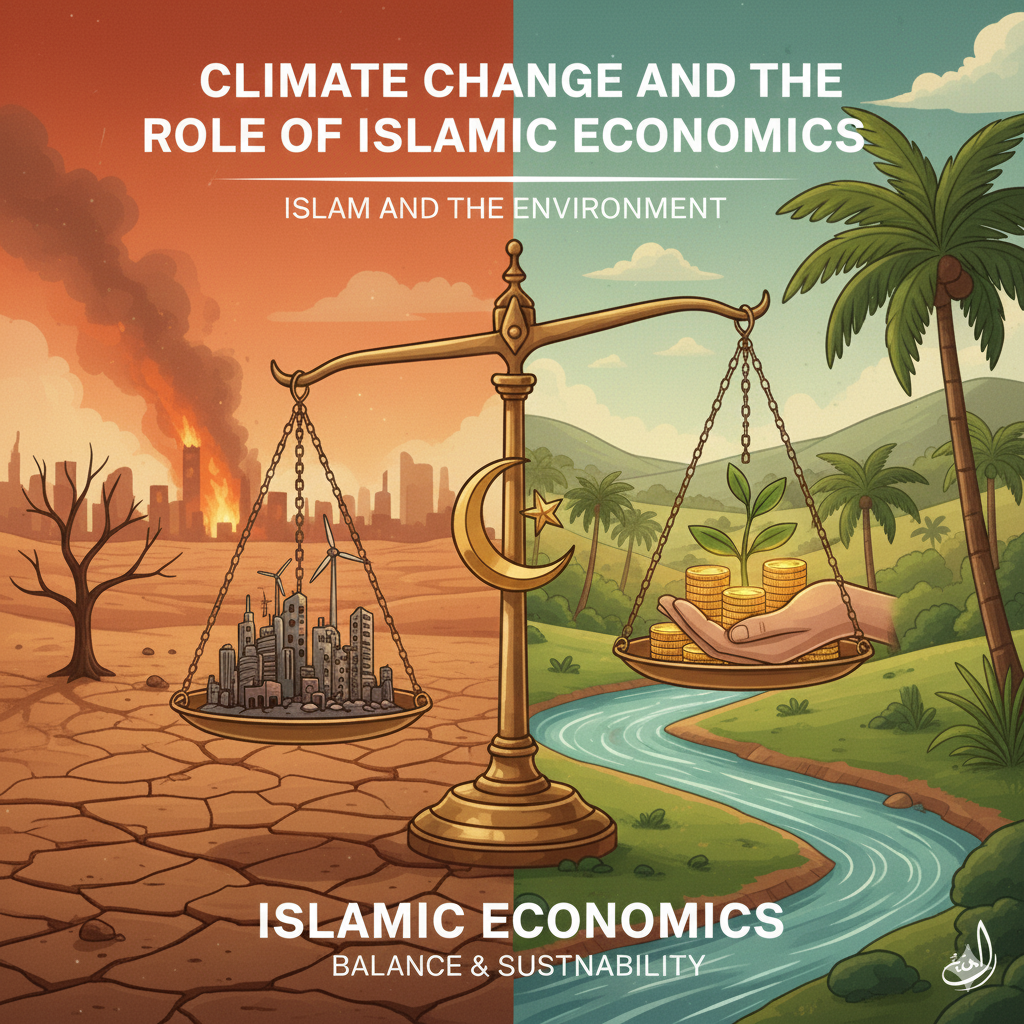
Every time the Quran discusses the natural world, it does so in terms of a balance, or a system of scales (mizan), which was established in Heaven at the same time as the heavens were raised and which is inviolable on all fronts, be they natural harmony or human justice, morality, or commerce. Islam is fundamentally about moderation, balance, and measure; when these are compromised—for example, when environmental degradation or fanaticism arises—Islam is betrayed and misrepresented.
And Heaven, He (Allah) raised it high, and established the Balance (saying), Do not transgress the Balance and give weight with equity, and let the Balance not fall short.
(Quran 55:7-9)
A Muslim's obligation comes before their right, and our rights are contingent on how we carry out our obligations. The rebel against the Lord has lost all rights because he no longer recognizes any obligations, and it is precisely this rebel that takes advantage of and consumes the things of this earth unjustly. Allah alone is the owner of all rights over His creation. Since He created us as creatures in constant need, our rights are derived from Him and are strictly constrained by those needs. It goes without saying that the idea of a man who is independent and self-sufficient based on his decisions should not go beyond the bounds of Shariah. It is the world of nature that sparkles with goodness and obedience to what is right for all creation to those who possess iman (faith).
In order to meet annual growth targets, the modern pursuit of success has been narrowed down to indicators such as GDP growth and industrialization; however, economic success would not be possible without the sensible management of environmental resources and unprejudiced transactions. True progress requires careful management of not only the economy but also the animals we live with, the forests that provide shade and bounty, the rivers that quench nature’s thirst and cool the Sun’s heat, and other many resources that our Creator has bestowed. Economic progress should not be an end in and of itself.
Man is no longer viewed in the modern era as the khalifah that he was entrusted to be, tending to his domain and caring for its inhabitants. Instead, man is consuming the planet as a predator and as an insolent taker. He consumes more and more and never feels satisfied. Notwithstanding, man has become the destroyer of the natural world on which he depends. Without conscionable boundaries and limits, his days will be numbered and his survival precarious. Man's role as nature's keeper has been undermined by his actions, and his anchor as the contemplator, picking up lessons from the land and his environment, has become an afterthought.
Islamic Economics and Finance are guided in their decision-making by legal pronouncements, prophetic traditions, and scripture. The Islamic financial system is strongly connected to the real economy and maintains accountability, and best practices in its conduct. Because of these qualities, Islamic Economics and Finance will be an essential component of sustainable development and the protection of the very resources that will allow us to pursue growth and expansion responsibly. The world craves for more justice and equality, but it will just be a pipedream if we do not implement and practice the system that upholds the very values that will enable justice and equality. Afterall, it is the actors within the system that ensures any system reaching its fullest potential.
REFERENCES
[1] World Meteorological Organization (2025). The State of the Global Climate 2024. https://wmo.int/publication-series/state-of-global-climate-2024
[2] UN Sustainable Development Goals (2019). UN Report: Nature’s Dangerous Decline ‘Unprecedented’; Species Extinction Rates ‘Accelerating’. https://www.un.org/sustainabledevelopment/blog/2019/05/nature-decline-unprecedented-report/
[3] Chu E.W., Karr J.R. Environmental Impact: Concept, Consequences, Measurement. Reference Module in Life Sciences. 2017:B978-0-12-809633-8.02380-3. doi: 10.1016/B978-0-12-809633-8.02380-3. Epub 2016 Oct 31. PMCID: PMC7157458.